> ## Documentation Index
> Fetch the complete documentation index at: https://kleros-mintlify-6ebc7975.mintlify.site/llms.txt
> Use this file to discover all available pages before exploring further.
# Curate
> Kleros Curate lets anyone build community-run lists and token registries, with jurors resolving disputes over incorrect or malicious submissions.
 # Curate
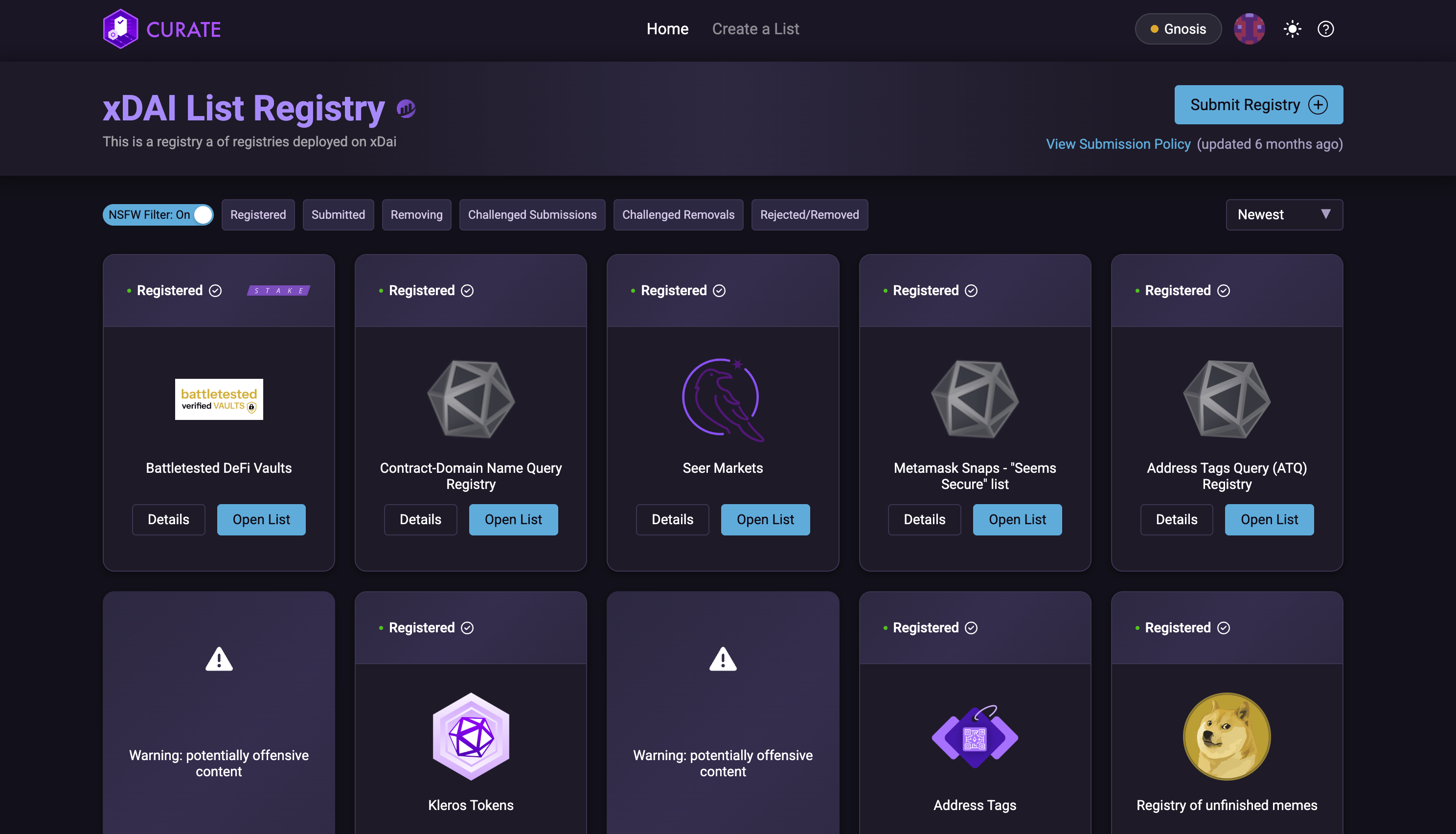
**Curate** is a decentralized application for creating and maintaining community-curated registries. Anyone can submit items to a list, and anyone can challenge incorrect or malicious submissions-with disputes resolved by Kleros Court.
Think of it as Wikipedia for structured data, but with economic skin in the game. Submitters stake a deposit that they lose if their submission is successfully challenged. Challengers risk their own deposit if the submission turns out to be valid. This creates a self-sustaining system where participants are economically incentivized to maintain accurate registries.
Curate powers critical infrastructure across Web3: token lists that wallets use to display assets, address tags that block explorers use to label contracts, and security registries that help users avoid scams.
***
## Curate Variants
Curate is a family of three variants. All three use the V1 Kleros Court for dispute resolution.
* **Classic Curate** (V1) - a full Token-Curated Registry (TCR) supporting complex schemas. Best for high-value registries with custom fields. Migrated to Gnosis Chain.
* **Light Curate** (V1) - a simplified TCR built for higher volume and lower gas costs. On Gnosis Chain.
* **Stake Curate** (V1 infrastructure) - continuous verification with permanent deposits, on Gnosis Chain. Deployed mid-August 2025; first implementation with DAMM Capital (September 2025). See [Stake Curate](/products/stake%20curate).
***
## Key Capabilities
Anyone can add items to a registry by staking a deposit
Anyone can challenge incorrect submissions
Contested items are decided by Kleros Court jurors
Create registries for any type of structured data
Registry data is fully on-chain and queryable
Successful challengers earn the submitter's deposit
***
## How It Works
Curate uses a mechanism called a **Token Curated Registry (TCR)**. Here's the flow:
A user submits an item (e.g., a token address with metadata) and stakes a deposit. The submission enters a **pending** state.
During the challenge period, anyone can challenge the submission by staking their own deposit. If no one challenges, the item is **accepted** into the registry.
If challenged, a dispute is created in Kleros Court. Jurors review the evidence and vote on whether the submission meets the registry's acceptance criteria.
The winning party receives both deposits (minus arbitration fees). The item is either **accepted** or **rejected** based on the ruling.
```mermaid theme={null}
flowchart LR
A[Submit Item] --> B{Challenge Period}
B -->|No challenge| C[✅ Accepted]
B -->|Challenged| D[Kleros Court]
D -->|Submitter wins| C
D -->|Challenger wins| E[❌ Rejected]
```
### The Incentive Structure
The beauty of TCRs is that **you don't need to trust anyone**:
* **Submitters** are incentivized to only submit valid items (or lose their deposit)
* **Challengers** are incentivized to only challenge invalid items (or lose their deposit)
* **Jurors** are incentivized to vote honestly (via Kleros's Schelling point mechanism)
This creates a self-policing system where bad actors are economically punished.
***
## Use Cases
**Problem:** Wallets and exchanges need to know which tokens are legitimate.
**Solution:** Community-curated token registries where anyone can submit tokens and anyone can challenge scams or duplicates.
**Example:** The Kleros Token Registry is used by wallets to display token information and warn users about unverified assets.
**Problem:** Block explorers show raw addresses with no context about what they are.
**Solution:** Registries that map addresses to human-readable labels (e.g., "Uniswap V3 Router", "Vitalik.eth").
**Example:** Address tag registries power the labels you see on Etherscan and other explorers.
**Problem:** Users can't easily verify if a smart contract is safe to interact with.
**Solution:** Security registries where auditors and community members flag risky or verified contracts.
**Example:** [Kleros Scout](/products/scout) displays security information from Curate registries.
**Problem:** Decentralized apps need reliable metadata (logos, descriptions, links).
**Solution:** Registries that store and serve verified content metadata.
**Example:** Token logos and project information served to dApps across the ecosystem.
### Who Uses Curate?
* **Wallets** query token registries to display asset information
* **Block explorers** use address tags for human-readable labels
* **DeFi protocols** check registries before listing new assets
* **Security tools** aggregate risk information from curated lists
* **DAOs** maintain member or contributor registries
***
## Registry Types
Curate offers three variants across the two protocol versions:
| Variant | Version | Best For | Gas Costs | Flexibility |
| ------------------------- | -------- | ----------------------------------------------- | --------- | -------------------------------------------- |
| **Classic Curate** (full) | V1 | High-value registries with complex schemas | Higher | Maximum |
| **Light Curate** | V1 | Simple registries, higher volume | Lower | Standard schemas |
| **Stake Curate** | V1 infra | Continuous verification with permanent deposits | - | See [Stake Curate](/products/stake%20curate) |
Among the V1 variants, most registries use **Light Curate** for cost efficiency. Classic Curate is used when you need custom fields or complex acceptance criteria.
***
## Current Status
As of the May 2026 development update, Curate V2 aligned its evidence query with the kleros-core schema migration and removed an unused evidence hook. Work is in progress to integrate a shared file-viewer component.
Follow development on the [Kleros blog - developer updates](https://blog.kleros.io/tag/developer/).
***
## What's Next?
**Step-by-step guides**
Learn how to submit items, challenge submissions, and earn rewards.
**Integration guide**
Query registry data, build custom UIs, or create your own registry.
→ Developer Docs
**Game theory deep dive**
Learn the economics and incentives behind Token Curated Registries.
→ Concepts
***
## Quick Links
Open the Curate application
Query registry data via GraphQL
Curate V2 deployment addresses
Guide to deploying your own registry
# Curate
**Curate** is a decentralized application for creating and maintaining community-curated registries. Anyone can submit items to a list, and anyone can challenge incorrect or malicious submissions-with disputes resolved by Kleros Court.
Think of it as Wikipedia for structured data, but with economic skin in the game. Submitters stake a deposit that they lose if their submission is successfully challenged. Challengers risk their own deposit if the submission turns out to be valid. This creates a self-sustaining system where participants are economically incentivized to maintain accurate registries.
Curate powers critical infrastructure across Web3: token lists that wallets use to display assets, address tags that block explorers use to label contracts, and security registries that help users avoid scams.
***
## Curate Variants
Curate is a family of three variants. All three use the V1 Kleros Court for dispute resolution.
* **Classic Curate** (V1) - a full Token-Curated Registry (TCR) supporting complex schemas. Best for high-value registries with custom fields. Migrated to Gnosis Chain.
* **Light Curate** (V1) - a simplified TCR built for higher volume and lower gas costs. On Gnosis Chain.
* **Stake Curate** (V1 infrastructure) - continuous verification with permanent deposits, on Gnosis Chain. Deployed mid-August 2025; first implementation with DAMM Capital (September 2025). See [Stake Curate](/products/stake%20curate).
***
## Key Capabilities
Anyone can add items to a registry by staking a deposit
Anyone can challenge incorrect submissions
Contested items are decided by Kleros Court jurors
Create registries for any type of structured data
Registry data is fully on-chain and queryable
Successful challengers earn the submitter's deposit
***
## How It Works
Curate uses a mechanism called a **Token Curated Registry (TCR)**. Here's the flow:
A user submits an item (e.g., a token address with metadata) and stakes a deposit. The submission enters a **pending** state.
During the challenge period, anyone can challenge the submission by staking their own deposit. If no one challenges, the item is **accepted** into the registry.
If challenged, a dispute is created in Kleros Court. Jurors review the evidence and vote on whether the submission meets the registry's acceptance criteria.
The winning party receives both deposits (minus arbitration fees). The item is either **accepted** or **rejected** based on the ruling.
```mermaid theme={null}
flowchart LR
A[Submit Item] --> B{Challenge Period}
B -->|No challenge| C[✅ Accepted]
B -->|Challenged| D[Kleros Court]
D -->|Submitter wins| C
D -->|Challenger wins| E[❌ Rejected]
```
### The Incentive Structure
The beauty of TCRs is that **you don't need to trust anyone**:
* **Submitters** are incentivized to only submit valid items (or lose their deposit)
* **Challengers** are incentivized to only challenge invalid items (or lose their deposit)
* **Jurors** are incentivized to vote honestly (via Kleros's Schelling point mechanism)
This creates a self-policing system where bad actors are economically punished.
***
## Use Cases
**Problem:** Wallets and exchanges need to know which tokens are legitimate.
**Solution:** Community-curated token registries where anyone can submit tokens and anyone can challenge scams or duplicates.
**Example:** The Kleros Token Registry is used by wallets to display token information and warn users about unverified assets.
**Problem:** Block explorers show raw addresses with no context about what they are.
**Solution:** Registries that map addresses to human-readable labels (e.g., "Uniswap V3 Router", "Vitalik.eth").
**Example:** Address tag registries power the labels you see on Etherscan and other explorers.
**Problem:** Users can't easily verify if a smart contract is safe to interact with.
**Solution:** Security registries where auditors and community members flag risky or verified contracts.
**Example:** [Kleros Scout](/products/scout) displays security information from Curate registries.
**Problem:** Decentralized apps need reliable metadata (logos, descriptions, links).
**Solution:** Registries that store and serve verified content metadata.
**Example:** Token logos and project information served to dApps across the ecosystem.
### Who Uses Curate?
* **Wallets** query token registries to display asset information
* **Block explorers** use address tags for human-readable labels
* **DeFi protocols** check registries before listing new assets
* **Security tools** aggregate risk information from curated lists
* **DAOs** maintain member or contributor registries
***
## Registry Types
Curate offers three variants across the two protocol versions:
| Variant | Version | Best For | Gas Costs | Flexibility |
| ------------------------- | -------- | ----------------------------------------------- | --------- | -------------------------------------------- |
| **Classic Curate** (full) | V1 | High-value registries with complex schemas | Higher | Maximum |
| **Light Curate** | V1 | Simple registries, higher volume | Lower | Standard schemas |
| **Stake Curate** | V1 infra | Continuous verification with permanent deposits | - | See [Stake Curate](/products/stake%20curate) |
Among the V1 variants, most registries use **Light Curate** for cost efficiency. Classic Curate is used when you need custom fields or complex acceptance criteria.
***
## Current Status
As of the May 2026 development update, Curate V2 aligned its evidence query with the kleros-core schema migration and removed an unused evidence hook. Work is in progress to integrate a shared file-viewer component.
Follow development on the [Kleros blog - developer updates](https://blog.kleros.io/tag/developer/).
***
## What's Next?
**Step-by-step guides**
Learn how to submit items, challenge submissions, and earn rewards.
**Integration guide**
Query registry data, build custom UIs, or create your own registry.
→ Developer Docs
**Game theory deep dive**
Learn the economics and incentives behind Token Curated Registries.
→ Concepts
***
## Quick Links
Open the Curate application
Query registry data via GraphQL
Curate V2 deployment addresses
Guide to deploying your own registry